
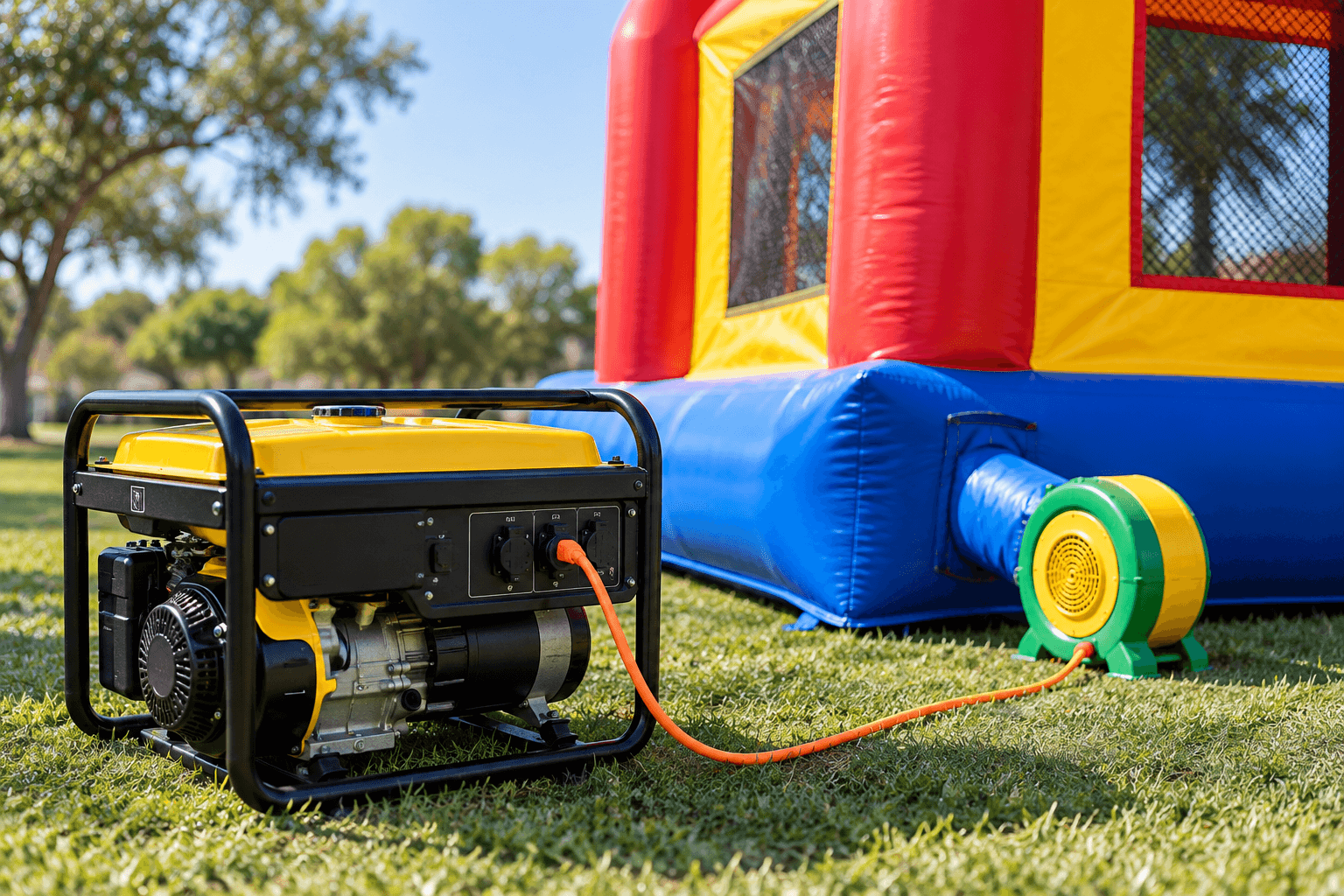
Do You Need a Generator for an Inflatable Rental? Blower Wattage and Outlet Requirements
You've found the perfect bounce house for your party. Setup location is picked. Guest list is growing. Then someone asks: "Do we have power out there?"
If your party site doesn't have an accessible outlet — or if the outlet is too far from your setup spot — you'll need a generator. But not all generators work. The wrong wattage, the wrong fuel plan, or the wrong circuit setup can shut your party down before it starts.
This guide explains exactly what size generator you need, how much power a bounce house blower actually draws, and what to do if you're hosting at a park with no outlet access.
Table of Contents
- Do Bounce Houses Need Electricity to Run?
- How Many Watts Does a Bounce House Blower Use?
- What Size Generator Do You Need for a Bounce House?
- Standard Outlet Requirements for Inflatable Rentals
- Dual Blower Units and Higher Wattage Needs
- Generator Fuel Runtime and Party Duration Planning
- Hosting at a Park with No Power Outlet
- Frequently Asked Questions
🏡 Backyard Party Host
You have an outdoor outlet, but it's 80 feet from the bounce house spot. You need to know if your standard household circuit can handle the blower.
🌳 Park Party Planner
You're hosting at a public park with zero power access. You need a generator — but you're not sure what size, how long it runs, or where to rent one.
🎪 Large Event Organizer
You're renting multiple inflatables or a large dual-blower combo unit. You need to calculate total wattage to avoid overloading circuits or undersizing the generator.
Do Bounce Houses Need Electricity to Run?
Yes. Every inflatable bounce house requires continuous electrical power to keep the blower motor running. The blower doesn't inflate the unit once and shut off — it runs the entire time children are playing.
Inflatables are not airtight. Air constantly escapes through the fabric and seams. The blower motor compensates by pushing a steady flow of fresh air into the unit. If power is interrupted, the inflatable begins deflating immediately. Within 5–10 minutes, it will be completely flat.

This is why reliable power access is the first logistical question when planning a bounce house rental. You need either a working electrical outlet within 100 feet of the setup location, or a generator powerful enough to run the blower for your entire event.
How Many Watts Does a Bounce House Blower Use?
Most residential bounce house blowers are rated between 1 HP and 1.5 HP. In electrical terms, that translates to:
- 1 HP blower: ~1,500 watts (12–13 amps at 120V)
- 1.5 HP blower: ~1,800–2,000 watts (15–16 amps at 120V)
- Commercial blower (2 HP+): 2,200–2,500 watts (18–20 amps at 120V)
Wattage determines what kind of power supply you need. If you're using a standard household outlet, a 20-amp dedicated circuit can handle most residential blowers. If you're using a generator, you need at least 2,000 watts of continuous output to run a single blower safely.
⚠️ Caution: Blower wattage is listed as "running watts," not "starting watts." Motors draw a brief surge when they first start — typically 1.5x to 2x the running wattage. A 1,500-watt blower may pull 2,200–3,000 watts for 2–3 seconds during startup. Your generator must handle that surge.
How Many Amps Does a Bounce House Blower Draw?
Amperage matters when evaluating outlet capacity. The formula is:
Amps = Watts ÷ Volts
For a 1,500-watt blower on a 120V circuit:
1,500 ÷ 120 = 12.5 amps
Standard household outlets are typically on 15-amp circuits. A 20-amp dedicated circuit is recommended for bounce house blowers to provide headroom for the startup surge and avoid tripping breakers.
What Size Generator Do You Need for a Bounce House?
For a single residential bounce house with a 1 HP to 1.5 HP blower, a 2,000-watt portable generator is the minimum safe size. A 2,500-watt generator provides more headroom and is the more common recommendation.
Minimum Size
2,000 Watts
- ✓ Single 1 HP blower
- ✓ Small to mid-size bounce house
- ✓ Budget-friendly rental
- ✗ No headroom for surge
- ✗ Not suitable for dual blowers
Recommended
2,500–3,000 Watts
- ✓ Single 1.5 HP blower
- ✓ Handles startup surge safely
- ✓ Powers mid to large bounce houses
- ✓ Extra capacity for lighting/speaker
- ✓ Most common rental size
Commercial / Multi-Unit
5,000+ Watts
- ✓ Dual blower units
- ✓ Multiple inflatables
- ✓ Large combo units with slides
- ✓ Commercial events
- ✓ Powers auxiliary equipment
Why Honda Generators Are the Industry Standard
When renting a generator for a party, Honda inverter generators (EU2200i or EU3000iS models) are the most commonly recommended for inflatable rentals. Here's why:
- Quiet operation: 48–57 dB at rated load (comparable to normal conversation)
- Fuel efficient: 8–10 hours runtime on a single tank at 25% load
- Clean power output: Safe for sensitive electronics (speakers, lighting controllers)
- Reliable starting: Electric start models reduce hassle
Other reputable brands include Yamaha, Champion, and Westinghouse. Avoid budget no-name generators for party use — unreliable power can damage blower motors and create safety risks.
Standard Outlet Requirements for Inflatable Rentals
If you're using household power instead of a generator, the outlet must meet three requirements:
1. Dedicated 20-Amp Circuit
The outlet should be on its own circuit breaker. Do not share the circuit with air conditioners, refrigerators, power tools, or other high-draw appliances. Shared circuits risk tripping during blower startup.
2. GFCI Protection
Outdoor outlets must have GFCI (Ground Fault Circuit Interrupter) protection to prevent electrical shock from moisture or ground faults. If your outlet is not GFCI-protected, use a portable GFCI adapter plug.
3. Within 100 Feet of Setup
Most rental companies provide a 50-foot extension cord with the blower. If the outlet is farther than 100 feet from the bounce house location, voltage drop becomes an issue. Use a heavy-duty 12-gauge extension cord rated for outdoor use.
🚨 Non-Negotiable: Never plug a bounce house blower into an indoor extension cord, a power strip, or a daisy-chained connection. These create fire and electrocution hazards. Always use a single, heavy-duty outdoor-rated extension cord if needed.
What If You Don't Have an Outdoor Outlet?
Some homes have no accessible outdoor outlet, or the only outlet is on the opposite side of the house. In that case, your options are:
- Run a cord through a window or door: Use a flat extension cord designed to fit under a closed door or window. Secure the door/window so it doesn't pinch the cord.
- Rent a generator: The cleaner solution. Eliminates cord routing issues entirely.
- Have an electrician install an outlet: A permanent solution if you host frequent backyard events.

Dual Blower Units and Higher Wattage Needs
Large combo units — bounce houses with attached slides, obstacle courses, or multi-chamber designs — often require two blowers running simultaneously. Each blower draws 1,500–2,000 watts, so total power demand can reach 3,000–4,000 watts.
If you're renting a dual-blower unit, confirm the following before your event:
- Generator size: Minimum 5,000 watts continuous output. A 6,500-watt generator provides safe headroom.
- Separate circuits: If using household power, each blower should plug into a separate 20-amp circuit. Do not run both blowers from the same outlet or circuit.
- Extension cord capacity: Each cord must be 12-gauge (minimum) and rated for the blower's amperage.
💡 Pro Tip: When renting a large combo unit, ask the rental company for their power specs sheet. Reputable companies provide a one-page document listing blower wattage, circuit requirements, and generator recommendations. This document prevents surprises on party day.
Generator Fuel Runtime and Party Duration Planning
One of the biggest generator mistakes is not accounting for fuel runtime. A bounce house blower runs continuously for the entire event — typically 3 to 6 hours for a birthday party. Your generator must have enough fuel capacity to last that long, or you must plan refueling breaks.
Typical Fuel Runtime by Generator Size
- 2,000-watt inverter generator (Honda EU2200i): 8–10 hours at 25% load (single blower)
- 3,000-watt inverter generator (Honda EU3000iS): 7–9 hours at 25% load
- 5,000-watt portable generator (standard): 6–8 hours at 50% load (dual blowers)
- 7,000-watt portable generator: 8–10 hours at 50% load
These estimates assume the generator is running at partial load — not full capacity. A blower running continuously is a steady, moderate load. Inverter generators (like Honda) are exceptionally fuel-efficient at this type of load.
What Happens If the Generator Runs Out of Fuel?
If the generator runs out of fuel mid-party, the blower stops, and the inflatable deflates. All children must exit immediately. Refuel the generator, restart the blower, and wait 3–5 minutes for the unit to fully re-inflate before allowing re-entry.
To avoid this scenario:
- Check fuel level before the party starts. Fill the tank completely.
- Monitor fuel level every 2 hours. Most generators have a fuel gauge or sight window.
- Keep extra fuel on-site. A 1-gallon gas can allows quick mid-party refueling if needed.
- Plan a refueling break. If your party is 6+ hours, schedule a 10-minute bounce house break for cake/food while you refuel.
Hosting at a Park with No Power Outlet
Public parks and beach picnic areas rarely have accessible electrical outlets. If you're hosting a bounce house party at a park, a generator is mandatory.
Here's what you need to arrange:
Generator Rental
Rent a 2,500–3,000 watt inverter generator from a local equipment rental company or home improvement store. Daily rental rates range from $50–$100.
Ask about fuel-included options. Some rental companies deliver with a full tank and pick up at the end of the day.
Fuel Supply
Bring 2–3 gallons of gasoline in an approved fuel container. Most parks prohibit open fuel storage, so keep the container in your vehicle and retrieve it when needed.
Never refuel a hot generator. Let it cool for 10 minutes before adding fuel.
Noise & Placement
Place the generator at least 15 feet away from the bounce house and party area. Inverter generators are quiet (~50 dB), but standard portable generators can be loud (70+ dB).
Check park rules — some prohibit generators entirely.
⚠️ Check Park Regulations: Some city and county parks prohibit generator use due to noise ordinances or fire risk. Confirm with the park's permit office before booking your bounce house rental.

Frequently Asked Questions
Do bounce houses need electricity to run? +
Yes, inflatable bounce houses require continuous electricity to power the blower motor. The blower constantly pushes air into the inflatable to maintain proper inflation. Without power, the inflatable will deflate within 5–10 minutes.
What size generator do I need for a bounce house? +
Most residential bounce houses use 1 HP to 1.5 HP blowers that draw 1,500 to 2,000 watts. A 2,000-watt (or 2kW) portable generator is typically sufficient. For dual-blower units or commercial inflatables, you'll need 3,500–5,000 watts. Always check your rental company's blower specifications.
How many amps does a bounce house blower use? +
Standard residential bounce house blowers draw 12 to 15 amps at 120 volts. A dedicated 20-amp circuit is recommended. Larger commercial inflatables or dual-blower setups may draw 20–25 amps combined.
Can I plug a bounce house into a regular outlet? +
Yes, most residential bounce houses can plug into a standard 120V household outlet on a dedicated 20-amp circuit. The outlet should be within 100 feet of the setup location. Avoid sharing the circuit with high-draw appliances like air conditioners or refrigerators.
What happens if the generator runs out of fuel during the party? +
If the generator runs out of fuel, the blower will stop, and the inflatable will begin deflating immediately. Children must exit before it fully deflates. Refuel the generator promptly, restart the blower, and allow 3–5 minutes for full re-inflation before allowing re-entry.
Do I need a GFCI outlet for a bounce house? +
Yes, GFCI (Ground Fault Circuit Interrupter) outlets are required by most bounce house rental agreements and safety standards, especially for outdoor setups. GFCI protection prevents electrical shock from moisture or ground faults. If your outdoor outlet is not GFCI-protected, use a portable GFCI adapter or a generator with built-in GFCI.
Understanding Power Requirements Makes Party Planning Easier
Knowing whether you need a generator — and what size — eliminates one of the biggest day-of-party stressors. Power planning is just as important as choosing the right bounce house.
If you're hosting at a park or a location with limited outlet access, a 2,500–3,000 watt generator covers most residential bounce house rentals safely. If you're using household power, confirm your outlet is on a dedicated 20-amp circuit and GFCI-protected.
For deeper guidance on selecting the right inflatable for your space and event type, explore our complete bounce house rental guide. For safety protocols and supervision best practices, see our guide on bounce house safety rules for parents.
Ready to Book Your Bounce House?
We handle setup, takedown, and provide clear power requirement documentation with every rental. No surprises. No stress. Just a great party.
Book Your Party Now!Questions? Call us at (858) 560-2700